Kirkland Shouldn’t Raise Costs for Seniors While Cutting Opportunities for Teens
Everyone wants workers to succeed and earn more. With housing, groceries, and everyday expenses continuing to strain family budgets, creating pathways to better-paying jobs should be a priority.
But wanting higher wages and mandating higher wages are not the same thing. Good intentions do not guarantee good economic policy. It’s easy to support a higher minimum wage in theory. It’s harder to explain to a family or a retiree why their grocery bill went up to pay for it.
Last week, the Kirkland City Council voted 7–0 to direct staff to gather Kirkland-specific business data and conduct outreach regarding a potential citywide minimum wage. Staff will report back by March 31, 2027, with research and potential draft ordinance options expected by June 30. No wage level has been adopted, but an earlier motion to draft an ordinance modeled on King County’s unincorporated rate of $20.82 an hour failed on a 3–4 vote before the Council settled on outreach. The scale of the increase under discussion is well above the state minimum.
Kirkland is hardly alone in wrestling with this issue. Tacoma is currently considering a $20 minimum wage and whether any increase should be phased in over time, while Olympia voters rejected a $20-an-hour proposal in 2025 and city leaders continue to study the issue. Meanwhile, Seattle, Renton, Tukwila, Everett, and other jurisdictions have already adopted local minimum wages above the state rate. The lesson is clear: there is no single regional approach, which is why Kirkland should base its decision on Kirkland’s own data and economic conditions.
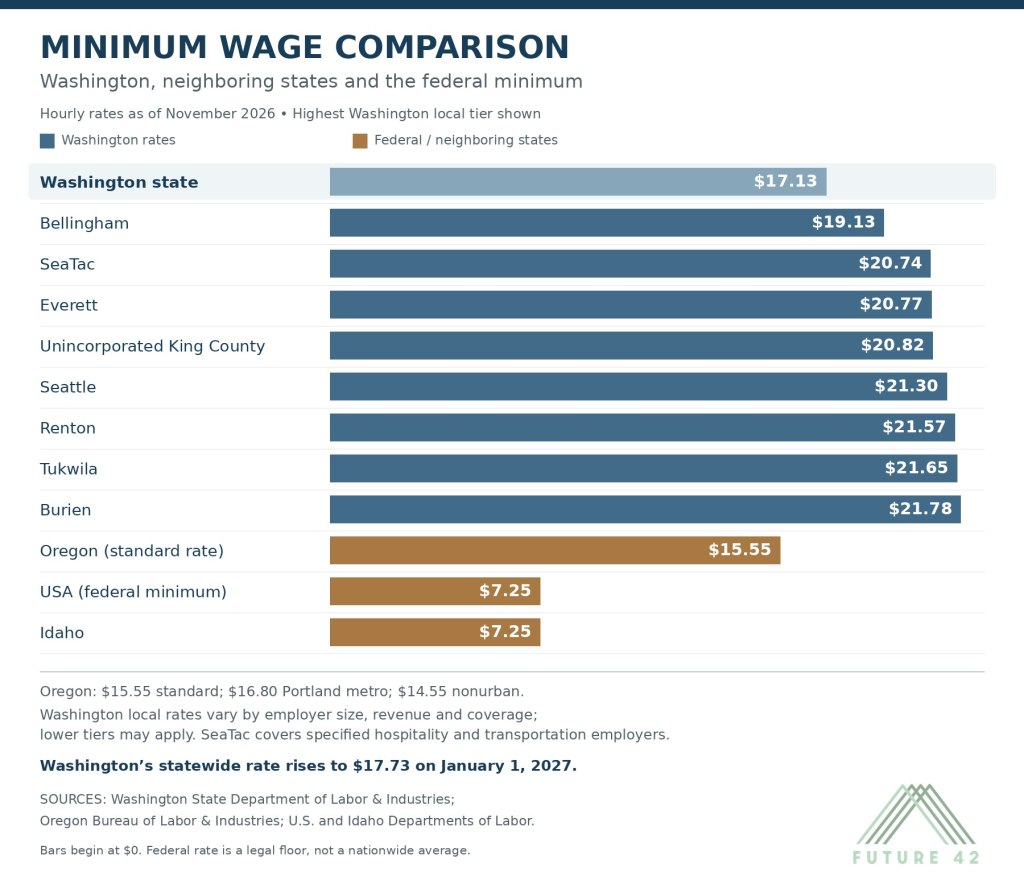
Before Kirkland goes further, councilmembers should ask two basic questions: How does it impact affordability for citizens in Kirkland as local businesses now have higher costs that will be reflected in higher prices for goods and services for everyone in the city, and why should it cost more to hire someone in Kirkland than Washington state already requires? It would be a significant step for Kirkland, which currently uses Washington’s $17.13-an-hour minimum wage as its baseline.
When government increases the cost of employing someone, businesses adjust. They can hire fewer people, reduce hours, raise prices, automate jobs, demand more experience from applicants, or simply decide against expansion.
The Congressional Budget Office has reached essentially this same conclusion at the federal level: raising the minimum wage would increase earnings for many low-wage workers while causing some workers to become jobless.
That tradeoff is especially important for teenagers, college students and first-time workers.
Research on Seattle’s minimum-wage increases, published in the American Economic Journal: Economic Policy, found significant reductions in hours, particularly among less-experienced workers, and a decline in hiring for new low-wage jobs. Kirkland’s own consultant points the same way. Its study found that Seattle’s ordinance did cause workers’ hours to be severely reduced. Fewer hours translate into less money in a family’s budget.
Seattle’s experience provides several cautionary lessons:
- Higher prices for goods and services: When labor costs rise, businesses must find ways to absorb those costs, which will include raising prices for customers in the city, reducing staffing or hours, or accepting smaller margins.
- Reduced hiring opportunities: Researchers found evidence of declining hiring for low-wage workers trying to enter Seattle’s labor market.
- Fewer hours worked: Low-wage workers experienced roughly a 7% reduction in hours as the minimum wage increased.
- Uneven benefits: Workers with more previous labor-market experience benefited more than less-experienced workers.
- No reduction in overall earnings inequality: Despite raising hourly wages, researchers found no evidence that the policy reduced overall earnings inequality.
- Higher costs for employers: Higher mandated wages increase payroll costs, creating additional pressure for labor-intensive businesses.
- A fundamental tradeoff: A higher hourly wage does little for someone who cannot get hired or whose available hours are reduced.
A higher minimum wage looks like a raise on paper, but for some of the people it’s meant to help, it arrives as a smaller paycheck. A parent who was promised a better wage instead sees shifts quietly cut and a schedule that no longer covers the rent. A teenager or someone starting over is told that the entry-level job they were counting on has gone to someone with more experience. The corner restaurant that knew every customer by name cuts hours, raises prices, or closes for good, and the people who worked there lose far more than a statistic suggests. When Seattle raised its minimum wage, University of Washington researchers found that hours worked in low-wage jobs fell while hourly pay rose by about 3 percent, which lowered the amount paid to workers in those jobs by an average of $74 a month per job in 2016. For those families, a raise on paper meant less money in hand.
Low-income families already spend a larger share of their budgets on groceries and basic necessities, so even small price increases hit them hardest. A national study of minimum wage increases found that consumers, rather than firms, bear the cost in retail, and that low-income households are disproportionately affected because groceries take up so much of their spending. The researchers estimated that each $1 increase reduces real income by about $19 a year for households earning under $10,000, through higher grocery prices alone. Some working families that receive housing, food, or health assistance also lose part of those benefits as their income rises, and one analysis found that benefit reductions offset about a third of the income gains for low-income families, which can leave a raise on paper doing less than promised.
Kirkland’s seniors face the same squeeze, with even less ability to adapt. Critics point out that higher wage mandates push prices up for everyone, which disproportionately affects retirees and others who live on fixed incomes. A retiree doesn’t get a bigger paycheck when the minimum wage goes up. She gets a higher bill at the grocery store, at the neighborhood restaurant, and for the home care, cleaning, and delivery services that older residents often depend on, all of which are labor-intensive. When someone on a fixed income pays more for the same groceries and the same help around the house, she is helping to cover the mandate, with no new wages to offset it.
Small businesses face the same reality.
A neighborhood restaurant, coffee shop, or retailer can’t simply manufacture additional money to cover a new mandate. Higher costs ultimately have to go somewhere: higher prices, fewer hours, fewer employees, reduced profits, or increased automation.
Then there is Kirkland’s competitiveness.
Businesses don’t choose locations in a vacuum. They can locate and expand elsewhere on the Eastside. Kirkland’s own economic competitiveness analysis already identified both advantages and costs in its business environment, including the benefit of not having a local B&O tax and the impact of higher utility taxes on some businesses.
Why deliberately add another cost to doing business inside Kirkland’s city limits?
The cumulative burden matters. Businesses already navigate taxes, fees, permitting, regulations, rent, insurance, and other rising expenses. No single government mandate may break a small business. It’s their accumulation that policymakers too often ignore.
If the Council keeps moving forward, it should at least do so with open eyes. The Greater Kirkland Chamber of Commerce has urged councilmembers to slow down and prioritize meaningful engagement with local businesses, nonprofits, and social service providers before proceeding. Staff should be asked to model what a higher wage would mean for Kirkland’s prices, for hours and hiring, and for seniors and low-income residents on tight budgets, not just for the workers who keep their jobs.
Washington already establishes a statewide minimum wage. Kirkland should stick with it and focus instead on making the city a place where employers can thrive and compete for workers by offering better wages and opportunities.
The minimum wage doesn’t just determine the least someone can be paid. It also establishes the minimum price an employer must pay to give someone a chance.
Kirkland should be making it easier to hire, invest, and grow, not searching for new ways to make doing business more expensive. A higher minimum wage sounds good, but it makes life more expensive for everyone, and it’s seniors on fixed incomes and low-income residents, the people with the least room in their budgets, who will feel it the most.