Bigger Budgets, Bigger Questions: Seattle and King County’s Decade of Government Growth
For years, the debate in Olympia has followed a familiar pattern: government spending grows, unsustainable budgets produce budget “shortfalls”, and the conversation quickly turns to finding more tax revenue.
But this challenge isn’t confined to state government.
The same pattern is playing out closer to home in Seattle and King County. And with budget season underway and families already struggling with an affordability crisis, it’s more important than ever that taxpayers pay attention to where their money is going and what they’re getting in return.
Over the last decade, local government spending in King County and Seattle has grown dramatically. Taxpayers have every right to ask a simple question:
Are we getting better results for all the additional money we’re spending?
Consider King County.
King County’s budget has grown dramatically over the past decade. Last year, the King County Council adopted a $20.16 billion budget for 2026–2027. That is more than double the approximately $9 billion biennial budget adopted for 2015–2016.
Seattle’s budget growth has been substantial as well.
Seattle’s 2016 proposed actual budget included more than $4 billion in annual appropriations, with approximately $1.1 billion in General Fund spending. Today, Seattle’s adopted 2026 budget totals $8.9 billion, including a $2 billion General Fund.
In other words, Seattle’s overall budget has roughly doubled in a decade, while its General Fund has grown by roughly 80%.
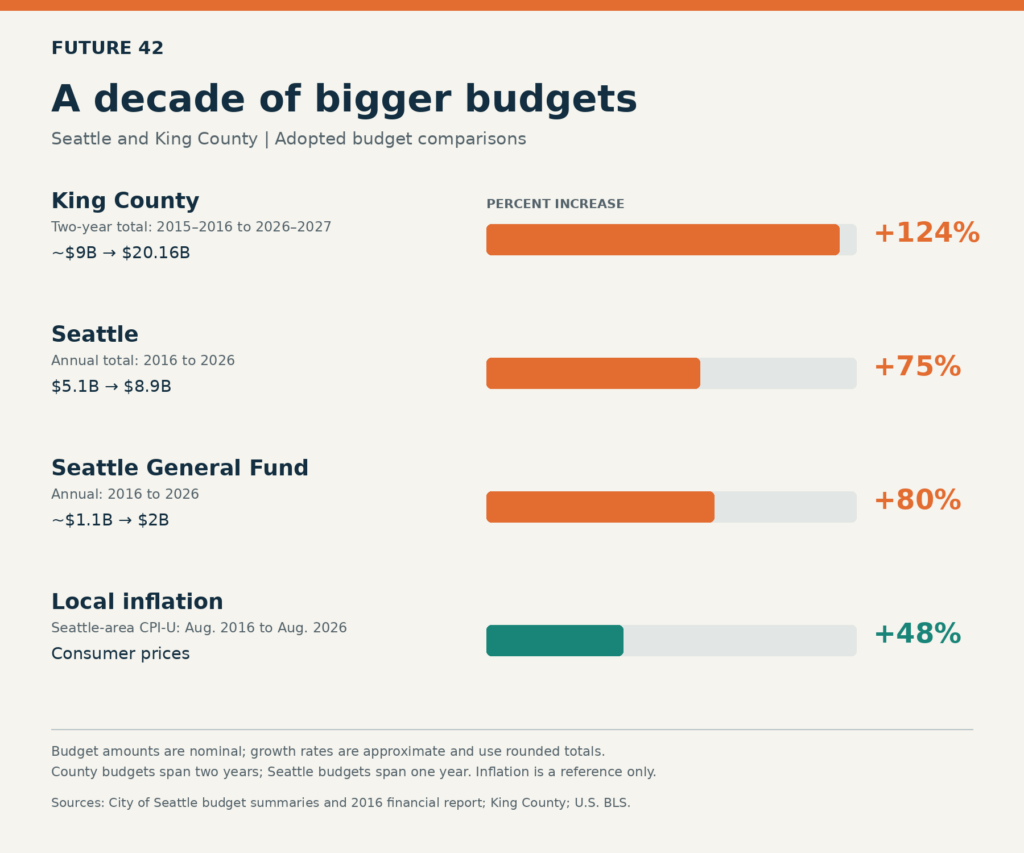
Those are remarkable increases.
To be fair, headline budget numbers require context. Neither Seattle nor King County’s budget is simply a giant checking account. Both governments operate utilities, transportation systems, infrastructure programs, and numerous dedicated funds. Population growth, inflation, labor costs, and capital investments matter too.
But government success shouldn’t be measured by how much money it spends. It should be measured by what taxpayers receive for that investment.
Consider homelessness.
A decade ago, Seattle was already confronting a serious homelessness crisis and investing nearly $50 million in homelessness programs and resources.
Today, Seattle’s 2026 budget identifies $225.2 million in citywide homelessness spending, including approximately $169 million through the Human Services Department. Of that, $125.4 million (56%) is allocated to the King County Regional Homelessness Authority (KCRHA).
That means Seattle is spending roughly four-and-a-half times as much on homelessness as it was a decade ago, while homelessness, per the King County Regional Homelessness Authority, grew from 10,730 people experiencing homelessness to 18,365 – a 71% increase.
Certainly, the homelessness crisis is complex. Wages, mental health, addiction treatment, housing costs, inflation, and the scope of services have all increased in cost, while the regional system for delivering those services has changed. But those factors make accountability more important, not less.
After a decade of dramatically higher spending, taxpayers deserve to know: What measurable outcomes have improved in proportion to that investment?
That doesn’t mean the additional spending accomplished nothing. Nor does it mean every program should be cut. It means spending more cannot itself be the measure of success.
And that principle goes well beyond homelessness.
Olympia does it. Seattle does it. King County does it.
When government spending grows this dramatically, elected leaders should demonstrate that existing dollars are being spent effectively before returning to taxpayers for more.
Seattle’s April 2025 revenue forecast projected $217.8 million in reductions to the city’s most flexible revenues across 2025 and 2026, including $50.4 million less for the General Fund. King County, despite its significant budget growth, projects a $120 million General Fund shortfall for 2028–2029.
That is why fiscal discipline matters.
Every new program can become an ongoing commitment. Higher baseline spending makes future budgets harder to balance. And when the default response is another tax, fee, or new revenue source, government avoids the harder work of setting priorities.
This isn’t an argument against government investment. Great communities require excellent public safety, transportation, infrastructure, parks, utilities, and human services.
But growth cannot substitute for prioritization, and spending cannot substitute for results.
Before Seattle or King County asks taxpayers for more, residents deserve answers:
What’s working? What isn’t?
What can be consolidated, reformed, or eliminated?
Where can technology provide better service at lower cost?
Which programs may be worthwhile, but aren’t a core responsibility of government?
Most importantly, after a decade of enormous spending growth, what measurable improvements should taxpayers actually be able to see and feel?
Our region and state are fortunate to have enormous resources. That makes fiscal discipline more important, not less.
The problem in Seattle and King County isn’t simply that government needs more revenue. We also have to confront how quickly spending has grown, what taxpayers are receiving for it, and whether elected leaders are willing to make hard choices about priorities.
During this budget season, and at a time when affordability is squeezing families across our region, taxpayers should be watching closely as Future 42 King County/Seattle will be, asking questions, and demanding results. It’s time to insist on a different approach and make government prove it is spending our money wisely before asking us for more. Contact your council member today and make your voice heard.
City of Seattle:
- Rob Saka — Councilmember, District 1, rob.saka@seattle.gov
- Eddie Lin — Councilmember, District 2, eddie.lin@seattle.gov
- Joy Hollingsworth — Councilmember, District 3, joy.hollingsworth@seattle.gov
- Maritza Rivera — Councilmember, District 4, maritza.rivera@seattle.gov
- Debora Juarez — Councilmember, District 5, debora.juarez@seattle.gov
- Dan Strauss — Councilmember, District 6, dan.strauss@seattle.gov
- Robert “Bob” Kettle — Councilmember, District 7, robert.kettle@seattle.gov
- Alexis Mercedes Rinck — Councilmember, Position 8 (Citywide), AlexisMercedes.Rinck@seattle.gov
- Dionne Foster — Councilmember, Position 9 (Citywide), dionne.foster@seattle.gov
- Entire Seattle City Council: council@seattle.gov
King County:
- Rod Dembowski — Councilmember, District 1, rod.dembowski@kingcounty.gov
- Rhonda Lewis — Councilmember, District 2, rhonda.lewis@kingcounty.gov
- Sarah Perry — Council Chair, District 3, sarah.perry@kingcounty.gov
- Jorge L. Barón — Vice Chair, District 4, jorge.baron@kingcounty.gov
- Steffanie Fain — Councilmember, District 5, steffanie.fain@kingcounty.gov
- Claudia Balducci — Councilmember, District 6, claudia.balducci@kingcounty.gov
- Pete von Reichbauer — Councilmember, District 7, pete.vonreichbauer@kingcounty.gov
- Teresa Mosqueda — Councilmember, District 8, teresa.mosqueda@kingcounty.gov
- Reagan Dunn — Vice Chair, District 9, reagan.dunn@kingcounty.gov