Whatcom County’s 2027–2028 Budget: Taxes, Public Safety, and Your Voice
Whatcom County Council is approaching important decisions on its proposed 2027–2028 biennial budget.
On Tuesday, November 10, the County Council will continue reviewing the proposed 2027-2028 biennial budget. The final budget ordinance and related tax levy measures are scheduled for introduction, with a final vote anticipated for November 24.
With affordability at the forefront of discussions across Washington, local budget decisions deserve attention. As the county considers spending reductions, additional tax revenues, and changes to how services are funded, an important question remains:
How can the county maintain essential services, address its financial challenges, and remain accountable to taxpayers?
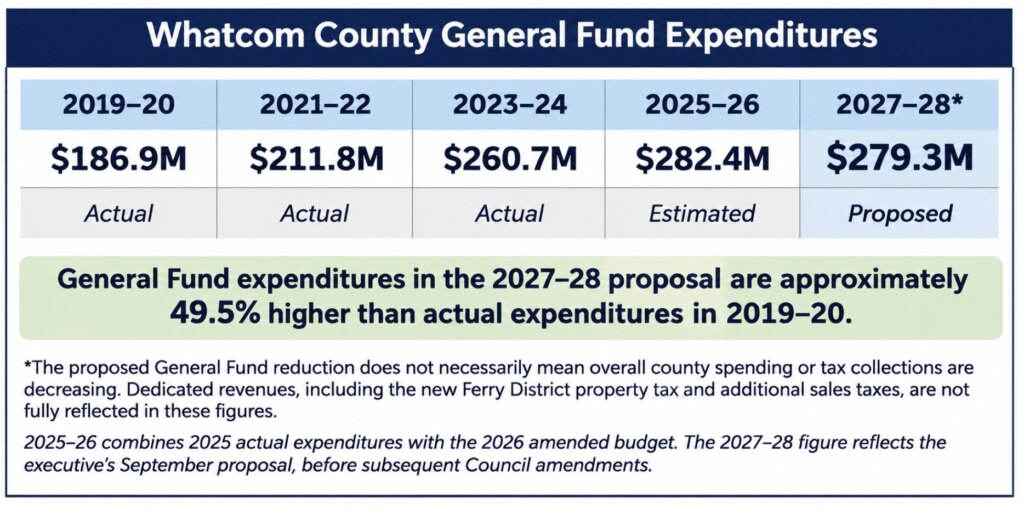
How Has County Spending Changed?
While the county’s overall budget includes dedicated funds, the General Fund, which is the County’s operations budget, provides a useful measure of spending on core county operations. The below graphic uses budget data from the County’s official website.
Public Safety: Where Is the New Sales Tax Revenue Going?
Earlier this year, Whatcom County approved a new 0.1% criminal justice and public safety sales tax, projected to generate approximately $7 million annually. Sheriff Donnell Tanksley supported the tax, and his office worked to meet the state’s eligibility requirements. However, the executive’s proposed budget included eliminating six patrol deputy positions that were previously approved by council.
During October budget deliberations, the council voted to restore four entry-level deputy positions and one deputy-in-training position. A subsequent proposal to add funding for the two remaining deputy positions failed 3–4, with Councilmembers Boyle, Galloway, Rienstra, and Scanlon opposing the proposal.
The question: With additional public safety tax revenue coming in, how much is being directed toward frontline law enforcement, and what staffing levels will residents ultimately receive?
Ferry District and Road Fund: Understanding the Taxpayer Impact
In July, the County Council voted 5–2 (Councilmembers Elenbaas and Stremler opposed) to approve a $5.7 million annual budget for the newly established Ferry District (taxing district for Lummi Island ferry service), choosing the highest of three tax levy options presented that did not require voter approval.
The new countywide property tax is approximately 8.7 cents per $1,000 of assessed value, adding an estimated $52 annually for a $600,000 home.
The Ferry District is intended to fund ferry operations and capital expenses while freeing the County’s Road Fund resources for other transportation needs. However, both funding sources will continue supporting the ferry system.
The question: How much of the ferry service expenditures will still come out of the road fund, and will taxpayers pay the same amount into the Road Fund alongside this new ferry district property tax?
Take Action: Whatcom County Budget Decisions
Residents can follow budget discussions and share their priorities with councilmembers at either November 10 meeting.
Tuesday, November 10, 2026
Location: Whatcom County Courthouse, Council Chambers, 311 Grand Avenue, Bellingham, WA.
9:00 a.m. Finance and Administrative Services Committee
Budget discussions and public comment on committee agenda items. Two minutes per speaker.
6:00 p.m. Regular County Council Meeting
Three minutes per speaker.
Participate or Contact Council
- Join virtually or find public comment instructions
- Email County Council: council@co.whatcom.wa.us
More Time for Budget Review
A voter-approved 2025 charter amendment that Future 42 supported now requires earlier submission of the county budget, giving councilmembers and residents more time to review proposals and provide input before adoption. We are already seeing the benefits of this change, with more time to examine budget priorities, ask questions, and engage in the decision-making process.
Review the Budget and Supporting Documents
Affordability isn’t just a statewide issue. Local budget decisions affect what residents pay in taxes, the services our community receives, and our long-term financial obligations.
Thank you for staying informed and engaged in the decisions that impact our community.